- joseph@shangzuchem.com
- Mon - Sat at 7:00AM to 9:00AM
Mar . 17, 2026 17:02 Back to list
What Are The Causes Of Poor Sandability And Workability Of Wall Putty?
What problems occur with wall putty?
Among all issues encountered in wall putty application, poor adhesion is one of the most severe, characterized by insufficient bonding strength between the putty and the substrate. This problem typically stems from improper surface treatment, excessive moisture content, or the use of low-quality binders in the putty formulation.
Shrinkage is another major challenge during the drying process. Excessive shrinkage of the putty results in an uneven surface, requiring additional coating and extensive rework. This issue is usually caused by an inappropriate water-to-powder ratio, overly rapid drying conditions, or insufficient polymer content in the mixture.
Dusting becomes evident when the dried putty surface leaves a chalky residue upon contact. This phenomenon indicates weak cohesion on the putty surface and often leads to poor adhesion of subsequent coatings. It is generally caused by an over-diluted putty mixture or the use of inappropriate binding polymers during formulation.
Workability issues manifest as difficult spreading, poor leveling, or premature setting of the putty mixture. These problems make application laborious and result in unstable surface quality. Poor workability is usually attributed to insufficient rheological modification or inadequate water retention in the putty formulation.
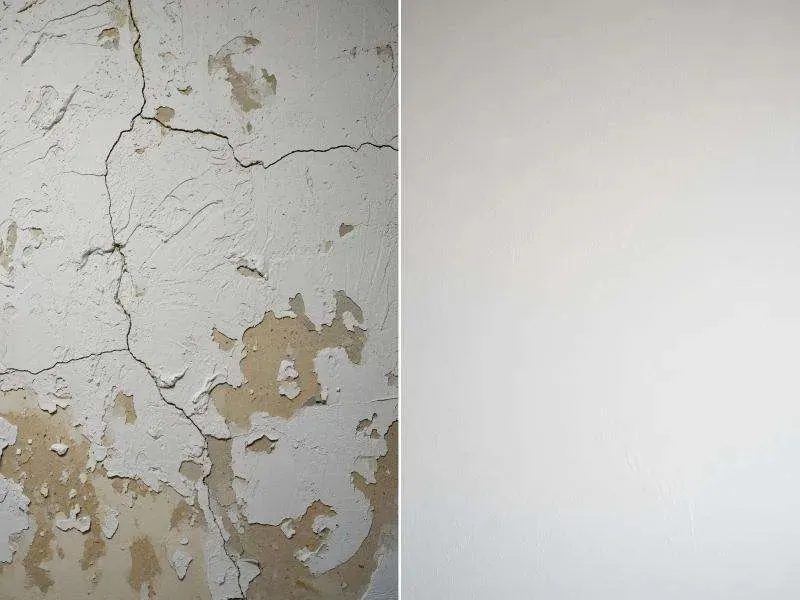
Why does wall putty crack?
Rapid moisture loss during curing is the primary cause of cracking. When moisture evaporates too quickly from the putty surface, internal stress develops, manifesting as visible cracks. This typically occurs in hot and dry climatic conditions or when applying putty in direct sunlight without proper protection.
Excessive thickness of a single putty layer frequently leads to cracking. A thick putty layer causes differential drying rates between the surface and the interior, creating internal tension that results in crack formation. Professional applications usually require multiple thin coats instead of a single thick layer to prevent this issue.
Improper substrate preparation also contributes to cracking. When putty is applied to a dusty, contaminated, or improperly prepared base surface, poor adhesion occurs, leading to stress concentration points that eventually form cracks over time.
Temperature fluctuations during curing cause cycles of expansion and contraction that exceed the flexibility limit of the putty. Such thermal stress particularly affects putty applications in regions with significant temperature variations.
For further questions regarding cracked wall putty, you may click on " " Cracked Wall Putty " to view more details.
Our products are specifically designed to address many cracking issues by providing excellent water retention. Controlling the release of moisture during curing ensures proper hydration and reduces the rapid moisture loss that typically causes cracking. In addition, our products enhance the flexibility and adhesion of wall putty formulations.
-
The global market size of powdered hydroxypropyl methylcellulose (HPMC) is projected to reach $990 million by 2032.
NewsMar.17,2026
-
Hydroxypropyl Methyl Cellulose (plastering gypsum)
NewsJun.10,2024
-
What is HPMC made from
NewsJun.10,2024
-
The role of hydroxypropyl methyl cellulose in various industries
NewsJun.10,2024
-
4 factors to HPMC water retention(1)
NewsJun.10,2024